
BALI The Land of Gods
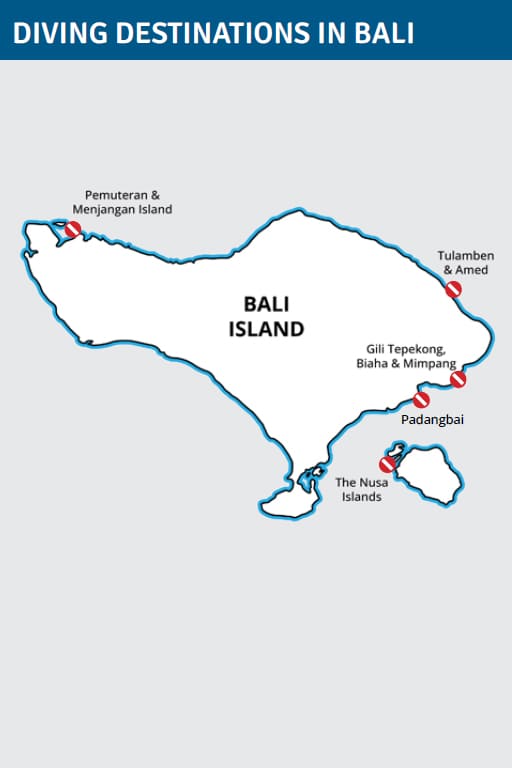 Bali, a compact island of 6,000 km², is rich in culture and natural beauty, stretching 153 km east–west and 112 km north– south. Home to over 4.3 million people (as of 2024), primarily Hindu, its culture blends Indian, Chinese, Hindu, and Buddhist influences, tracing back to the Majapahit Empire. Balinese Hinduism, rooted in Indian traditions, emphasizes balance between good and evil, shaping daily rituals and ceremonies. The island is also renowned for its traditional arts, including painting, sculpture, wood carving, and mask-making. Bali has a tropical climate, characterized by warm temperatures year-round, with an average temperature of 27°C. The wet season typically occurs from November to March.
Diving Overview
Bali offers diverse diving experiences, from tranquil bays to challenging sites with strong currents and thermoclines, suitable for all levels. Marine life is abundant, with opportunities to see large pelagics like mola and manta rays, as well as macro wonders like pygmy seahorses, frogfish, and ghost pipefish, making Bali a top destination for both big fish and macro enthusiasts.
Diving Conditions
Diving conditions around Bali vary by location. Sites like Pemuteran, Menjangan, Amed, and Tulamben offer calm, beginner-friendly dives, while the Nusa Islands and Gili Tepekong can experience strong currents, especially during the full moon.
Dive Site and Marine Life Highlights in BALI
Bali’s dive sites cater to all interests. Spot manta rays and mola mola at Nusa Penida, macro life at Tulamben, sharks at Gili Tepekong, and turtles at Menjangan and Pemuteran. Wreck divers can explore the USAT Liberty and Kubu wrecks in Tulamben. For drift dives, head to Nusa Penida, Tepekong, or Mimpang. For relaxed diving, visit Menjangan, Pemuteran, or Bali’s east coast. Stay in southern Bali for vibrant nightlife and easy access to top sites, or visit Nusa Lembongan, Ceningan, and Penida for pristine tropical reefs.
BALI The Land of Gods
Bali, a compact island of 6,000 km², is rich in culture and natural beauty, stretching 153 km east–west and 112 km north– south. Home to over 4.3 million people (as of 2024), primarily Hindu, its culture blends Indian, Chinese, Hindu, and Buddhist influences, tracing back to the Majapahit Empire. Balinese Hinduism, rooted in Indian traditions, emphasizes balance between good and evil, shaping daily rituals and ceremonies. The island is also renowned for its traditional arts, including painting, sculpture, wood carving, and mask-making. Bali has a tropical climate, characterized by warm temperatures year-round, with an average temperature of 27°C. The wet season typically occurs from November to March.
Diving Overview
Bali offers diverse diving experiences, from tranquil bays to challenging sites with strong currents and thermoclines, suitable for all levels. Marine life is abundant, with opportunities to see large pelagics like mola and manta rays, as well as macro wonders like pygmy seahorses, frogfish, and ghost pipefish, making Bali a top destination for both big fish and macro enthusiasts.
Diving Conditions
Diving conditions around Bali vary by location. Sites like Pemuteran, Menjangan, Amed, and Tulamben offer calm, beginner-friendly dives, while the Nusa Islands and Gili Tepekong can experience strong currents, especially during the full moon.
Dive Site and Marine Life Highlights in BALI
Bali’s dive sites cater to all interests. Spot manta rays and mola mola at Nusa Penida, macro life at Tulamben, sharks at Gili Tepekong, and turtles at Menjangan and Pemuteran. Wreck divers can explore the USAT Liberty and Kubu wrecks in Tulamben. For drift dives, head to Nusa Penida, Tepekong, or Mimpang. For relaxed diving, visit Menjangan, Pemuteran, or Bali’s east coast. Stay in southern Bali for vibrant nightlife and easy access to top sites, or visit Nusa Lembongan, Ceningan, and Penida for pristine tropical reefs.
TULAMBEN & AMED
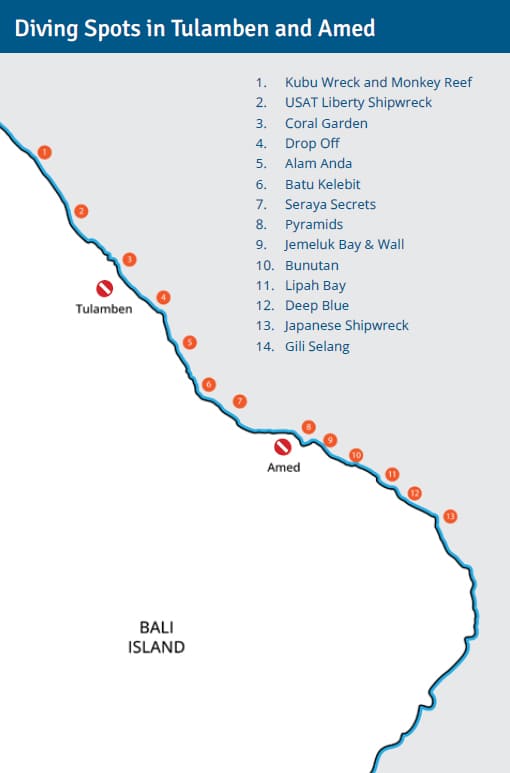 Tulamben and Amed are top diving destinations in Bali, home to the iconic USAT Liberty wreck. These areas feature a variety of sites, from wrecks and black sand muck dives to colorful reefs and shallow coral gardens. With easy shore access, diverse marine life, and great photography opportunities, they’re ideal for divers of all levels.
How To Get There
- Fly to Bali Ngurah Rai International Airport (DPS)
- Transfer by car to Tulamben or Amed (2.5 - 3 hours), often arranged by dive resorts
Diving Conditions
Tulamben and Amed offer easy shore and boat diving, with calmer waters compared to Bali’s open sea and Nusa Islands. While currents are generally mild, windy periods can make shore entries challenging. Water temperatures remain stable, and visibility may decrease during the rainy season due to runoff. These areas are ideal for divers of all levels, including beginners.
Visibility : 10 - 30 m
Best Time : May - Nov
Thermoclines possible Jun–Sep; brief dips to 24–26°C at depth.
Dive Site and Marine Life Highlights in Tulamben And Amed
The USAT Liberty Shipwreck, resting between 5 - 30 meters deep, is a must-dive site in Tulamben, famous for its haunting silhouette and vibrant marine life. Divers can spot nudibranchs, scorpionfish, pygmy seahorses, barracuda, and turtles. Night dives reveal bumphead parrotfish and rare crustaceans. Other notable sites include the Drop-Off wall, the Coral Garden featuring anemones and Balinese statues, and macro-havens such as Seraya and Emerald. In Amed, wrecks such as aircraft, ferries, and tugboats are teeming with reef fish. Jemeluk Bay is ideal for beginners, offering calm waters, rich marine life, and rewarding night dives. Blackwater dives and freediving on Liberty’s superstructure are also available.
TULAMBEN & AMED
Tulamben and Amed are top diving destinations in Bali, home to the iconic USAT Liberty wreck. These areas feature a variety of sites, from wrecks and black sand muck dives to colorful reefs and shallow coral gardens. With easy shore access, diverse marine life, and great photography opportunities, they’re ideal for divers of all levels.
How To Get There
- Fly to Bali Ngurah Rai International Airport (DPS)
- Transfer by car to Tulamben or Amed (2.5 - 3 hours), often arranged by dive resorts
Diving Conditions
Tulamben and Amed offer easy shore and boat diving, with calmer waters compared to Bali’s open sea and Nusa Islands. While currents are generally mild, windy periods can make shore entries challenging. Water temperatures remain stable, and visibility may decrease during the rainy season due to runoff. These areas are ideal for divers of all levels, including beginners.
Visibility : 10 - 30 m
Best Time : May - Nov
Thermoclines possible Jun–Sep; brief dips to 24–26°C at depth.
Dive Site and Marine Life Highlights in Tulamben And Amed
The USAT Liberty Shipwreck, resting between 5 - 30 meters deep, is a must-dive site in Tulamben, famous for its haunting silhouette and vibrant marine life. Divers can spot nudibranchs, scorpionfish, pygmy seahorses, barracuda, and turtles. Night dives reveal bumphead parrotfish and rare crustaceans. Other notable sites include the Drop-Off wall, the Coral Garden featuring anemones and Balinese statues, and macro-havens such as Seraya and Emerald. In Amed, wrecks such as aircraft, ferries, and tugboats are teeming with reef fish. Jemeluk Bay is ideal for beginners, offering calm waters, rich marine life, and rewarding night dives. Blackwater dives and freediving on Liberty’s superstructure are also available.
PADANGBAI
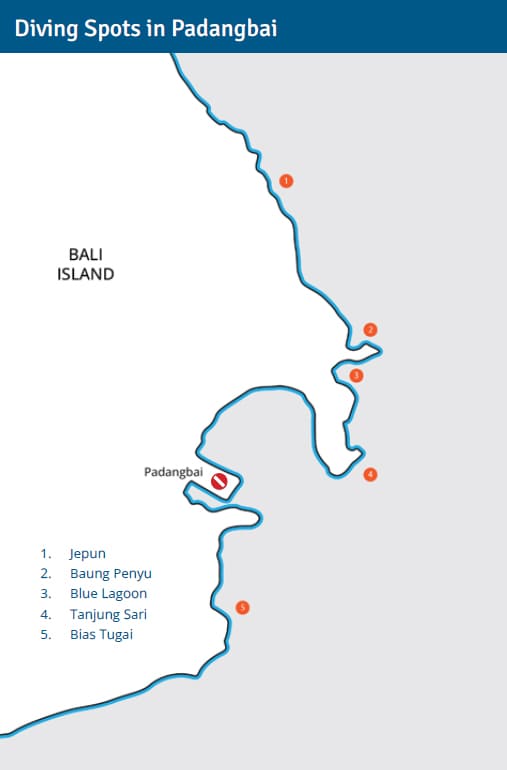 Padangbai, a small port town and ferry gateway to Lombok and the Gili Islands, is popular among backpackers for its white-sand beach and relaxed atmosphere. As a dive hub, it features sloping coral reefs, muck diving, the well-known Blue Lagoon, and a boat wreck, offering rich marine life and top-notch critter dives that make it a must-visit for divers.
How To Get There
- Fly to Bali Ngurah Rai International Airport (DPS)
- Transfer by car to Padangbai (1.5 hours)
Diving Conditions
Diving conditions in Padangbai vary from site to site. The main fringing reef features sloping sites with frequent currents, ideal for drift diving. Blue Lagoon is beginner-friendly, but it can experience surges and lower visibility during rough seas.
Visibility : 10 - 30 m
Best Time : May - Oct
Known for strong currents and eddies, upwellings Jun–Sep lower visibility
Dive Site and Marine Life Highlights in Padangbai
The Blue Lagoon is a must-dive site, featuring a vibrant coral garden and steep slope where turtles and occasional whitetip reef sharks can be spotted. Nearby, Jepun is a favorite for macro photographers, with critters and a wreck attracting yellow snappers, Moorish idols, and more. The Jetty is known for its rare finds, including frogfish, ghost pipefish, and stingrays. However, not all dive operators visit there, so it's best to confirm in advance. Other marine life includes moray eels, octopus, pygmy seahorses, and a variety of crustaceans. For freedivers, the lagoon’s edges offer depth, but caution is needed due to strong currents and surface boat traffic.
PADANGBAI
Padangbai, a small port town and ferry gateway to Lombok and the Gili Islands, is popular among backpackers for its white-sand beach and relaxed atmosphere. As a dive hub, it features sloping coral reefs, muck diving, the well-known Blue Lagoon, and a boat wreck, offering rich marine life and top-notch critter dives that make it a must-visit for divers.
How To Get There
- Fly to Bali Ngurah Rai International Airport (DPS)
- Transfer by car to Padangbai (1.5 hours)
Diving Conditions
Diving conditions in Padangbai vary from site to site. The main fringing reef features sloping sites with frequent currents, ideal for drift diving. Blue Lagoon is beginner-friendly, but it can experience surges and lower visibility during rough seas.
Visibility : 10 - 30 m
Best Time : May - Oct
Known for strong currents and eddies, upwellings Jun–Sep lower visibility
Dive Site and Marine Life Highlights in Padangbai
The Blue Lagoon is a must-dive site, featuring a vibrant coral garden and steep slope where turtles and occasional whitetip reef sharks can be spotted. Nearby, Jepun is a favorite for macro photographers, with critters and a wreck attracting yellow snappers, Moorish idols, and more. The Jetty is known for its rare finds, including frogfish, ghost pipefish, and stingrays. However, not all dive operators visit there, so it's best to confirm in advance. Other marine life includes moray eels, octopus, pygmy seahorses, and a variety of crustaceans. For freedivers, the lagoon’s edges offer depth, but caution is needed due to strong currents and surface boat traffic.
THE NUSA ISLANDS (Lembongan, Penida & Ceningan)
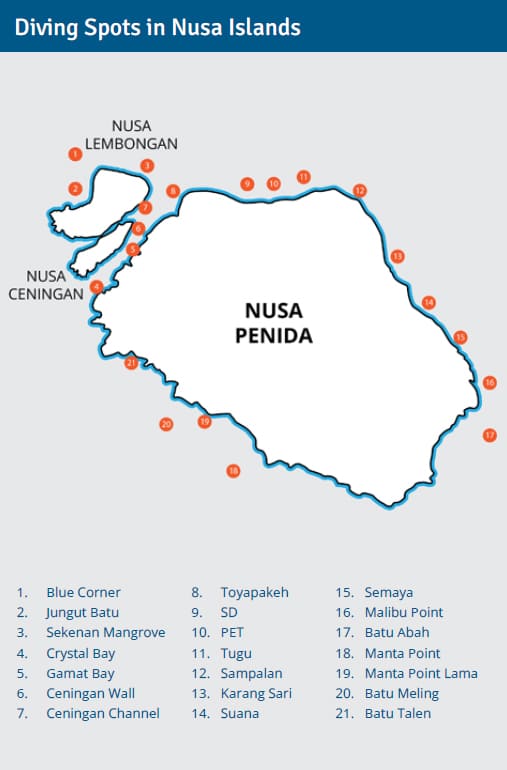 The Nusa Islands—Nusa Penida, Nusa Lembongan, and Nusa Ceningan—are located 12 km east of Bali and offer a relaxed atmosphere with growing tourism. Lembongan and Ceningan are linked by the Yellow Bridge, rebuilt after its 2016 collapse. While Penida is newer to tourism, it now features dive centers, restaurants, bars, and wellness spots. Speedboats from Sanur take approximately 45 minutes and operate only during daylight hours, typically including hotel or airport transfers.
How To Get There
- Fly to Bali Ngurah Rai International Airport (DPS)
- Transfer by car to Sanur (30 - 45 minutes), often arranged by dive resorts
- Fast boats to nearby islands (30 - 45 minutes), depart regularly from Sanur
Diving Conditions
The Nusa Islands are known for strong currents, especially during full moons, due to the Indonesian Throughflow. Drift dives are common along the north coasts of Nusa Penida and Lembongan, with currents ranging from mild to intense. The south coast of Penida (Manta Point I & II) is prone to surges and may be inaccessible during large swells. The channel between Ceningan and Penida has unpredictable cross currents and updrafts.
Visibility : 15 - 35 m
Best Time : May - Nov
Strong currents (drift diving), seasonal upwellings Jul–Oct can drop visibility and temperature sharply.
Dive Site and Marine Life Highlights in Nusa Islands
Whether you stay on Nusa Lembongan, Ceningan, or Penida, you will dive the same sites, as the islands are close together. For big fish encounters, the Nusa Islands deliver. Nusa Penida features two manta ray sites: Manta Point (cleaning station) and Manta Bay (feeding ground). Crystal Bay is famous for seasonal mola sightings, vibrant reefs, and a bat cave. The north coasts of Penida and Lembongan offer drift dives with rich coral and seasonal pelagics, such as barracuda and jacks. Stronger current sites, such as Toyapakeh Bay and Ceningan Wall, attract large fish schools. Blue Corner, suited for advanced divers, offers sightings of rays, barracuda, and tuna. On the East Coast, Sampalan is known for its fire corals and diverse marine life. Lembongan Bay, especially farther out, provides excellent conditions for freediving and training.
THE NUSA ISLANDS (Lembongan, Penida & Ceningan)
The Nusa Islands—Nusa Penida, Nusa Lembongan, and Nusa Ceningan—are located 12 km east of Bali and offer a relaxed atmosphere with growing tourism. Lembongan and Ceningan are linked by the Yellow Bridge, rebuilt after its 2016 collapse. While Penida is newer to tourism, it now features dive centers, restaurants, bars, and wellness spots. Speedboats from Sanur take approximately 45 minutes and operate only during daylight hours, typically including hotel or airport transfers.
How To Get There
- Fly to Bali Ngurah Rai International Airport (DPS)
- Transfer by car to Sanur (30 - 45 minutes), often arranged by dive resorts
- Fast boats to nearby islands (30 - 45 minutes), depart regularly from Sanur
Diving Conditions
The Nusa Islands are known for strong currents, especially during full moons, due to the Indonesian Throughflow. Drift dives are common along the north coasts of Nusa Penida and Lembongan, with currents ranging from mild to intense. The south coast of Penida (Manta Point I & II) is prone to surges and may be inaccessible during large swells. The channel between Ceningan and Penida has unpredictable cross currents and updrafts.
Visibility : 15 - 35 m
Best Time : May - Nov
Strong currents (drift diving), seasonal upwellings Jul–Oct can drop visibility and temperature sharply.
Dive Site and Marine Life Highlights in Nusa Islands
Whether you stay on Nusa Lembongan, Ceningan, or Penida, you will dive the same sites, as the islands are close together. For big fish encounters, the Nusa Islands deliver. Nusa Penida features two manta ray sites: Manta Point (cleaning station) and Manta Bay (feeding ground). Crystal Bay is famous for seasonal mola sightings, vibrant reefs, and a bat cave. The north coasts of Penida and Lembongan offer drift dives with rich coral and seasonal pelagics, such as barracuda and jacks. Stronger current sites, such as Toyapakeh Bay and Ceningan Wall, attract large fish schools. Blue Corner, suited for advanced divers, offers sightings of rays, barracuda, and tuna. On the East Coast, Sampalan is known for its fire corals and diverse marine life. Lembongan Bay, especially farther out, provides excellent conditions for freediving and training.
GILI TEPEKONG, BIAHA & MIMPANG
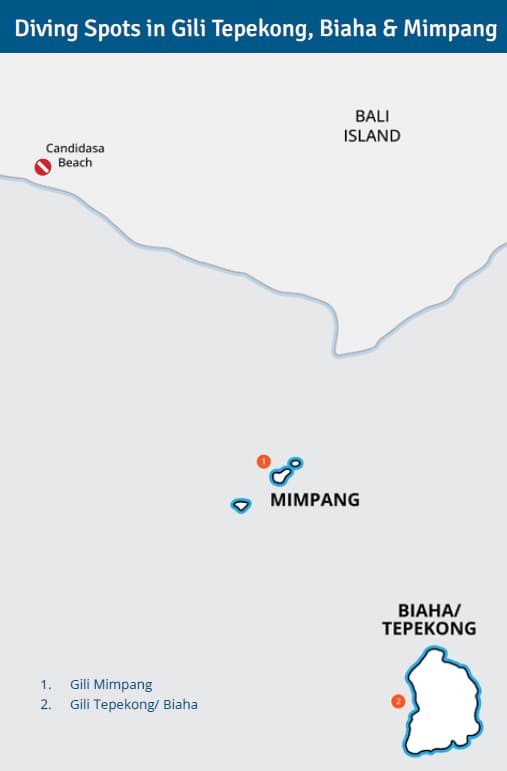 The rocky islets off Bali’s east coast are known for rugged terrain, rich macro life, and impressive pelagic sightings. Divers can encounter white-tip reef sharks, mola-mola (Aug–Nov), and occasional manta rays. The main draw is the big fish, strong currents, and spectacular reefs capes.
How To Get There
- Fly to Bali Ngurah Rai International Airport (DPS)
- Transfer by car to Padangbai (1.5 hours), often arranged by dive resorts
Diving Conditions
These open-ocean sites are best suited for experienced divers, particularly those who are confident in navigating strong currents and surges. Some require quick, negative entries.
Visibility : 10 - 25 m
Best Time : May - Oct
Strong down-currents and surges; upwellings Jul–Oct bring cooler temperature and reduced visibility
Dive Site and Marine Life Highlights in Gili Tepekong, Biaha, and Mimpang
Gili Tepekong features walls, slopes, and drop-offs with strong currents. It’s home to leaf scorpionfish, nudibranchs, frogfish, and schools of silver fish, with frequent sightings of barracuda, reef sharks, and mola-mola in season. At Biaha, the famous Shark Cave (12 meters) hosts white-tip reef sharks and spiny lobsters, along with moray eels, turtles, and cuttlefish. Gili Mimpang has three rock pinnacles and varied terrain. Shark Point is a highlight, known for its white-tip shark and mola sightings, although strong currents make it best suited for experienced divers.
GILI TEPEKONG, BIAHA & MIMPANG
The rocky islets off Bali’s east coast are known for rugged terrain, rich macro life, and impressive pelagic sightings. Divers can encounter white-tip reef sharks, mola-mola (Aug–Nov), and occasional manta rays. The main draw is the big fish, strong currents, and spectacular reefs capes.
How To Get There
- Fly to Bali Ngurah Rai International Airport (DPS)
- Transfer by car to Padangbai (1.5 hours), often arranged by dive resorts
Diving Conditions
These open-ocean sites are best suited for experienced divers, particularly those who are confident in navigating strong currents and surges. Some require quick, negative entries.
Visibility : 10 - 25 m
Best Time : May - Oct
Strong down-currents and surges; upwellings Jul–Oct bring cooler temperature and reduced visibility
Dive Site and Marine Life Highlights in Gili Tepekong, Biaha, and Mimpang
Gili Tepekong features walls, slopes, and drop-offs with strong currents. It’s home to leaf scorpionfish, nudibranchs, frogfish, and schools of silver fish, with frequent sightings of barracuda, reef sharks, and mola-mola in season. At Biaha, the famous Shark Cave (12 meters) hosts white-tip reef sharks and spiny lobsters, along with moray eels, turtles, and cuttlefish. Gili Mimpang has three rock pinnacles and varied terrain. Shark Point is a highlight, known for its white-tip shark and mola sightings, although strong currents make it best suited for experienced divers.
PEMUTERAN & MENJANGAN ISLAND
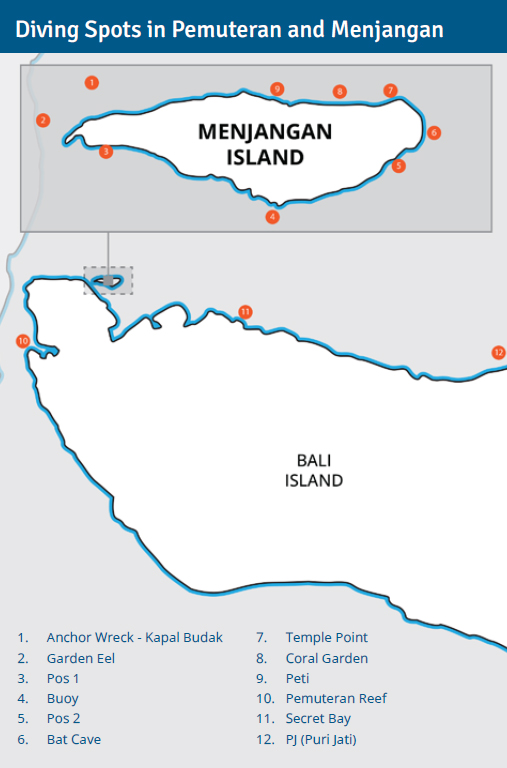 Pemuteran, a peaceful coastal town located near Bali Barat National Park, is renowned for its natural beauty, black-sand beaches, and crystal-clear waters. Less touristy than southern Bali, it still offers a range of accommodation and dining options. Nearby Menjangan Island, accessible by boat, requires permits and guides and is home to the rare Javan deer, as well as cultural sites like the Ganesh statue at the Segara Giri Dharma Kencana Temple. With diverse dive sites and a tranquil setting, the area is ideal for relaxation and naturefocused exploration.
How To Get There
- Fly to Bali Ngurah Rai International Airport (DPS)
- Transfer by car to Pemuteran (3.5 - 4 hours), for boat transfer
- A short boat trip to Menjangan Island
Diving Conditions
The Menjangan–Pemuteran area offers a variety of dive sites, including walls around Menjangan Island, sloping reefs in Pemuteran, and muck diving at Secret Bay. Sheltered and mostly current-free, the area suits divers of all levels. Pelagic sightings, including occasional whales, are more common between June and October.
Visibility : 15 - 30 m
Best Time : May - Oct
Mild cooling Jul–Sep.
Dive Site and Marine Life Highlights in Pemuteran & Menjangan Island
Menjangan's Cave II is a wall dive with vertical rifts and corals. Sandy Slope offers vibrant corals and diverse reef fish, with potential shark and turtle sightings from July to October. Secret Bay is a muck dive known for frogfish and mimic octopus. The Bio Rock project in Pemuteran supports coral restoration and attracts marine life, ideal for freediving.
PEMUTERAN & MENJANGAN ISLAND
Pemuteran, a peaceful coastal town located near Bali Barat National Park, is renowned for its natural beauty, black-sand beaches, and crystal-clear waters. Less touristy than southern Bali, it still offers a range of accommodation and dining options. Nearby Menjangan Island, accessible by boat, requires permits and guides and is home to the rare Javan deer, as well as cultural sites like the Ganesh statue at the Segara Giri Dharma Kencana Temple. With diverse dive sites and a tranquil setting, the area is ideal for relaxation and naturefocused exploration.
How To Get There
- Fly to Bali Ngurah Rai International Airport (DPS)
- Transfer by car to Pemuteran (3.5 - 4 hours), for boat transfer
- A short boat trip to Menjangan Island
Diving Conditions
The Menjangan–Pemuteran area offers a variety of dive sites, including walls around Menjangan Island, sloping reefs in Pemuteran, and muck diving at Secret Bay. Sheltered and mostly current-free, the area suits divers of all levels. Pelagic sightings, including occasional whales, are more common between June and October.
Visibility : 15 - 30 m
Best Time : May - Oct
Mild cooling Jul–Sep.
Dive Site and Marine Life Highlights in Pemuteran & Menjangan Island
Menjangan's Cave II is a wall dive with vertical rifts and corals. Sandy Slope offers vibrant corals and diverse reef fish, with potential shark and turtle sightings from July to October. Secret Bay is a muck dive known for frogfish and mimic octopus. The Bio Rock project in Pemuteran supports coral restoration and attracts marine life, ideal for freediving.


