
MALUKU The Land of Spices
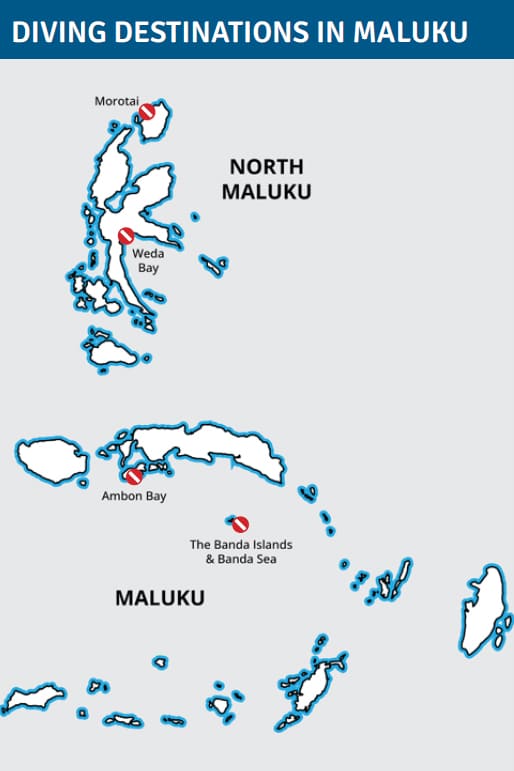 The Maluku Islands, also known as the Spice Islands, lie between Sulawesi and Papua, spanning over 850,000 km², mostly ocean. Shaped by tectonic forces, the region boasts volcanic peaks, rainforests, coral reefs, and a rich biodiversity, featuring many endemic species. Historically prized for nutmeg and cloves, Maluku was a center of colonial rivalry before becoming part of Indonesia. Now divided into North Maluku and Maluku provinces, the region is home to approximately 3 million people living in harmony. With its varied climates and fertile land, agriculture remains vital, producing a range of products including spices, sago, rice, and seafood. Papeda with fish soup is a well-known regional dish.
Diving Overview
Diving in the Maluku Islands requires more planning than in established destinations like Bali, but the rewards are substantial. With few dive centers and resorts, early arrangements are essential to access the region’s remote and pristine underwater sites.
Diving Conditions
Dive sites vary widely, from deep atoll walls in Halmahera to shallow muck slopes in Ambon, featuring both vibrant reefs and rare macro life. Some operators pause between June and September due to reduced visibility during the wet monsoon season, so it’s best to check ahead if you plan to visit during this time.
Dive Site and Marine Life Highlights in MALUKU
Maluku offers a remarkable diversity of diving experiences for all skill levels and interests. Ambon Bay is renowned for macro photography, home to rare species like the psychedelic frogfish. In contrast, Weda Bay in Halmahera features dramatic walls, giant gorgonians, and regular pelagic sightings—perfect for wide-angle enthusiasts. The Banda Sea, a favorite destination for liveaboards, showcases pristine reefs, schooling hammerhead sharks, and frequent encounters with whales and dolphins. From May to September, North Halmahera’s islands, including Rao and Morotai, reveal varied underwater landscapes—from shallow coral gardens to deep walls teeming with marine life. Snorkelers and freedivers will enjoy the clear, vibrant waters of Weda and the Banda Sea. Though more challenging, snorkeling in Ambon Bay can yield sightings of Indonesia’s rarest marine species. With low visitor numbers, sites like Weda Bay, Morotai, and the Banda Sea offer tranquil, crowd-free diving in some of the country’s most untouched waters.
MALUKU The Land of Spices
The Maluku Islands, also known as the Spice Islands, lie between Sulawesi and Papua, spanning over 850,000 km², mostly ocean. Shaped by tectonic forces, the region boasts volcanic peaks, rainforests, coral reefs, and a rich biodiversity, featuring many endemic species. Historically prized for nutmeg and cloves, Maluku was a center of colonial rivalry before becoming part of Indonesia. Now divided into North Maluku and Maluku provinces, the region is home to approximately 3 million people living in harmony. With its varied climates and fertile land, agriculture remains vital, producing a range of products including spices, sago, rice, and seafood. Papeda with fish soup is a well-known regional dish.
Diving Overview
Diving in the Maluku Islands requires more planning than in established destinations like Bali, but the rewards are substantial. With few dive centers and resorts, early arrangements are essential to access the region’s remote and pristine underwater sites.
Diving Conditions
Dive sites vary widely, from deep atoll walls in Halmahera to shallow muck slopes in Ambon, featuring both vibrant reefs and rare macro life. Some operators pause between June and September due to reduced visibility during the wet monsoon season, so it’s best to check ahead if you plan to visit during this time.
Dive Site and Marine Life Highlights in MALUKU
Maluku offers a remarkable diversity of diving experiences for all skill levels and interests. Ambon Bay is renowned for macro photography, home to rare species like the psychedelic frogfish. In contrast, Weda Bay in Halmahera features dramatic walls, giant gorgonians, and regular pelagic sightings—perfect for wide-angle enthusiasts. The Banda Sea, a favorite destination for liveaboards, showcases pristine reefs, schooling hammerhead sharks, and frequent encounters with whales and dolphins. From May to September, North Halmahera’s islands, including Rao and Morotai, reveal varied underwater landscapes—from shallow coral gardens to deep walls teeming with marine life. Snorkelers and freedivers will enjoy the clear, vibrant waters of Weda and the Banda Sea. Though more challenging, snorkeling in Ambon Bay can yield sightings of Indonesia’s rarest marine species. With low visitor numbers, sites like Weda Bay, Morotai, and the Banda Sea offer tranquil, crowd-free diving in some of the country’s most untouched waters.
AMBON BAY
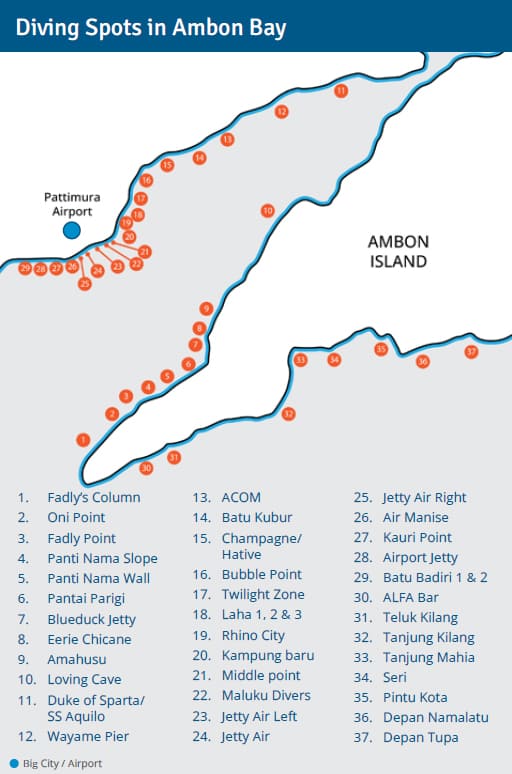 Ambon Island, situated southwest of Seram and spanning 51 km in length, is characterized by lush rainforests, fertile terrain, and a bay that nearly divides the island in two. Ambon City sits on the northeastern coast, while rural villages are scattered across the western and southern regions. Agriculture, particularly nutmeg and cloves, and fishing are the island’s primary industries, with tourism still emerging. Ambon is also a key liveaboard hub for trips across the Banda Sea and Maluku region. Most dive resorts and liveaboards provide transfer services. Bahasa Indonesia is widely spoken, and basic English is commonly used in tourism and business.
How To Get There
- Fly to Ambon Pattimura Airport (AMQ)
- Ships from Jakarta, Surabaya, or Makassar to Ambon are also available. Please check for schedules.
Diving Conditions
The best diving season in Ambon runs from November to May. Monsoon conditions in July and August can reduce visibility, and some operators may close during this period. Most dive sites are shallow, around 15 meters, with minimal currents, making them suitable for divers of all levels. The Duke of Sparta Wreck offers a deeper option for wreck enthusiasts. For reef diving, Weda Bay, Morotai, and the Banda Sea are excellent alternatives.
Visibility : 10 - 20 m
Best Time : Oct - Apr
Occasional cooler spells Jul–Sep to 26–28°C.
Dive Site and Marine Life Highlights in Ambon Bay
Ambon Bay is a world-class muck diving destination, renowned for its rare macro species, including frogfish, mimic and blueringed octopuses, rhinopias, flamboyant cuttlefish, and mandarin fish. Most dive sites are shallow, calm, and ideal for macro photography. Key sites include Laha, known for its diverse critters and mandarin fish at sunset; Tawiri, with sandy slopes that host frogfish, ghost pipefish, eels, and octopus; and Air Manis Jetty, offering a wealth of macro life alongside coral patches and schooling reef fish. Rhino City is famous for rhinopias and colorful anemones, while the Duke of Sparta Wreck, at 137 meters long, provides a deeper wreck dive experience. While coral cover in the bay is limited, the outer coast features wall dives and caves. Snorkeling and freediving are possible, though visibility is variable and coral growth is sparse.
AMBON BAY
Ambon Island, situated southwest of Seram and spanning 51 km in length, is characterized by lush rainforests, fertile terrain, and a bay that nearly divides the island in two. Ambon City sits on the northeastern coast, while rural villages are scattered across the western and southern regions. Agriculture, particularly nutmeg and cloves, and fishing are the island’s primary industries, with tourism still emerging. Ambon is also a key liveaboard hub for trips across the Banda Sea and Maluku region. Most dive resorts and liveaboards provide transfer services. Bahasa Indonesia is widely spoken, and basic English is commonly used in tourism and business.
How To Get There
- Fly to Ambon Pattimura Airport (AMQ)
- Ships from Jakarta, Surabaya, or Makassar to Ambon are also available. Please check for schedules.
Diving Conditions
The best diving season in Ambon runs from November to May. Monsoon conditions in July and August can reduce visibility, and some operators may close during this period. Most dive sites are shallow, around 15 meters, with minimal currents, making them suitable for divers of all levels. The Duke of Sparta Wreck offers a deeper option for wreck enthusiasts. For reef diving, Weda Bay, Morotai, and the Banda Sea are excellent alternatives.
Visibility : 10 - 20 m
Best Time : Oct - Apr
Occasional cooler spells Jul–Sep to 26–28°C.
Dive Site and Marine Life Highlights in Ambon Bay
Ambon Bay is a world-class muck diving destination, renowned for its rare macro species, including frogfish, mimic and blueringed octopuses, rhinopias, flamboyant cuttlefish, and mandarin fish. Most dive sites are shallow, calm, and ideal for macro photography. Key sites include Laha, known for its diverse critters and mandarin fish at sunset; Tawiri, with sandy slopes that host frogfish, ghost pipefish, eels, and octopus; and Air Manis Jetty, offering a wealth of macro life alongside coral patches and schooling reef fish. Rhino City is famous for rhinopias and colorful anemones, while the Duke of Sparta Wreck, at 137 meters long, provides a deeper wreck dive experience. While coral cover in the bay is limited, the outer coast features wall dives and caves. Snorkeling and freediving are possible, though visibility is variable and coral growth is sparse.
WEDA BAY (HALMAHERA)
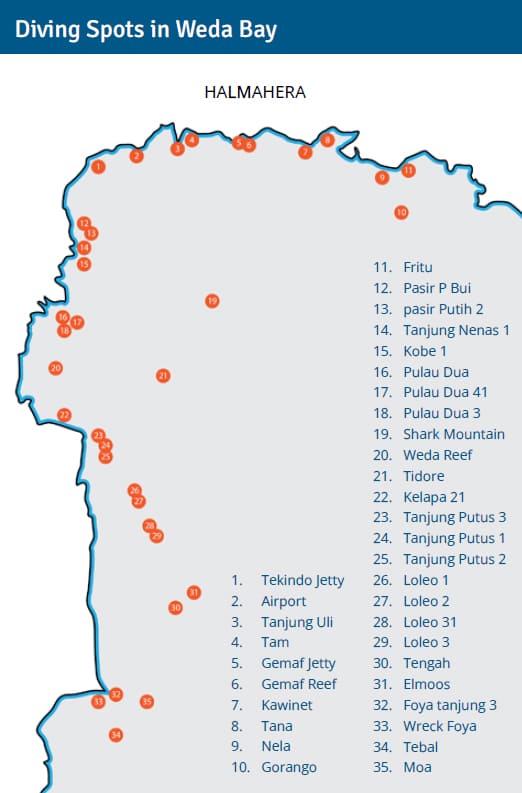 Halmahera is characterized by dense rainforests and striking mountainous terrain, particularly in the southeast, around Weda Bay. Most residents live in coastal villages, relying on fishing and farming, while mining plays a growing economic role. The main gateway is Ternate, followed by a 30-minute speedboat to Sofifi and a 4-hour rainforest drive to Weda Bay. Travel relies on roads and sea, with remote routes often requiring a 4WD vehicle. The fertile land produces coconuts, sago, and nutmeg. Ternate is mainly Muslim, while rural areas are more diverse. Modest dress is recommended, and with little English spoken, basic Indonesian is both helpful and appreciated.
How To Get There
- Fly to Ternate Sultan Babullah Airport (TTE)
- Continue by fast boat to Sofifi (30 minutes), followed by a 4-hour drive
Diving Conditions
Weda Bay features warm, clear waters and uncrowded sites ranging from shallow coral gardens to deep walls and sea mounts. Conditions suit all levels, although some operators close from June to September during the monsoon season, so check ahead. Many sites are remote, reached by GPS, and offer a truly exclusive experience— often with no other dive boats in sight.
Visibility : 15-30 m
Best Time : Oct - Apr
Very stable warm water year-round.
Dive Site and Marine Life Highlights in Weda Bay
Topography is dramatic and reefs are pristine, with standout sites like Elmoo’s Reef, Shark Mountain, and Gorango. Divers can expect to see vibrant corals, a variety of macroinvertebrates, reef sharks, and occasional pelagic species. Snorkelers and freedivers will enjoy vivid reefs, though fish density is moderate. Due to the area’s remoteness, proper boat support and caution are essential. Above the surface, vast rainforests and rare birdlife—such as Birds of Paradise—add to Weda Bay’s off-the-grid appeal.
WEDA BAY (HALMAHERA)
Halmahera is characterized by dense rainforests and striking mountainous terrain, particularly in the southeast, around Weda Bay. Most residents live in coastal villages, relying on fishing and farming, while mining plays a growing economic role. The main gateway is Ternate, followed by a 30-minute speedboat to Sofifi and a 4-hour rainforest drive to Weda Bay. Travel relies on roads and sea, with remote routes often requiring a 4WD vehicle. The fertile land produces coconuts, sago, and nutmeg. Ternate is mainly Muslim, while rural areas are more diverse. Modest dress is recommended, and with little English spoken, basic Indonesian is both helpful and appreciated.
How To Get There
- Fly to Ternate Sultan Babullah Airport (TTE)
- Continue by fast boat to Sofifi (30 minutes), followed by a 4-hour drive
Diving Conditions
Weda Bay features warm, clear waters and uncrowded sites ranging from shallow coral gardens to deep walls and sea mounts. Conditions suit all levels, although some operators close from June to September during the monsoon season, so check ahead. Many sites are remote, reached by GPS, and offer a truly exclusive experience— often with no other dive boats in sight.
Visibility : 15-30 m
Best Time : Oct - Apr
Very stable warm water year-round.
Dive Site and Marine Life Highlights in Weda Bay
Topography is dramatic and reefs are pristine, with standout sites like Elmoo’s Reef, Shark Mountain, and Gorango. Divers can expect to see vibrant corals, a variety of macroinvertebrates, reef sharks, and occasional pelagic species. Snorkelers and freedivers will enjoy vivid reefs, though fish density is moderate. Due to the area’s remoteness, proper boat support and caution are essential. Above the surface, vast rainforests and rare birdlife—such as Birds of Paradise—add to Weda Bay’s off-the-grid appeal.
THE BANDA ISLANDS
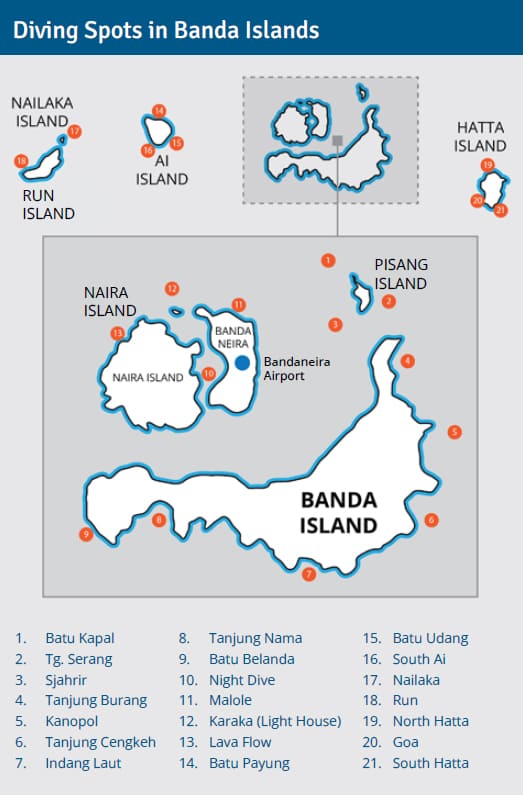 Once the center of the global spice trade, the Banda Sea now draws divers with its pristine reefs, historic islands, and exceptional marine life. With little human impact, its nutrient-rich waters are home to schooling hammerheads, mobula rays, Napoleon wrasse, and dogtooth tuna. Top dive sites include Batu Kapal and Gunung Api. Most trips are liveaboard-based and often combined with destinations such as Alor, the Spice Islands, or the Forgotten Islands, offering an immersive journey through Indonesia’s central seas.
How To Get There
- Fly to Ambon Pattimura Airport (AMQ) and take a regional flight to Banda Neira (NDA)
- Ships from Jakarta, Surabaya, Makassar, and Ambon to Banda Neira are also available. Please check for schedules.
Diving Conditions
The amazing dive sites of the Banda Islands are best visited in March and April, as well as during the period from September to December. These two periods offer more consistently calm conditions. Snorkelers and freedivers will enjoy pristine reefs, calm conditions, and warm, clear waters. The area suits all levels, although experienced freedivers should ensure they have surface support due to its remoteness. Liveaboards offer the most comprehensive access, though select land-based resorts also serve the region well.
Visibility : 20 - 40 m
Best Time : Oct - Apr
Generally stable; can be glassy-warm Sep–Nov.
Dive Site and Marine Life Highlights in the Banda Islands
The Banda Islands offer a diverse range of dive sites, dramatic topography, and a thriving marine ecosystem. Highlights include shark encounters at Pulau Ai, vibrant coral reefs at Batu Udang, and dense schools of fish at Karnobol. Batu Wali, located within a marine protected area, boasts spawning grounds and healthy reefs, while Batu Kapal is renowned for its striking pinnacles and sea fans. In the broader Banda Sea, top sites include Koon Island’s drift wall with barracuda and jacks, Nusa Laut’s diverse reef life, Pombo Boi’s idyllic tropical diving, and the action-packed, fish-rich waters of Suangi.
THE BANDA ISLANDS
Once the center of the global spice trade, the Banda Sea now draws divers with its pristine reefs, historic islands, and exceptional marine life. With little human impact, its nutrient-rich waters are home to schooling hammerheads, mobula rays, Napoleon wrasse, and dogtooth tuna. Top dive sites include Batu Kapal and Gunung Api. Most trips are liveaboard-based and often combined with destinations such as Alor, the Spice Islands, or the Forgotten Islands, offering an immersive journey through Indonesia’s central seas.
How To Get There
- Fly to Ambon Pattimura Airport (AMQ) and take a regional flight to Banda Neira (NDA)
- Ships from Jakarta, Surabaya, Makassar, and Ambon to Banda Neira are also available. Please check for schedules.
Diving Conditions
The amazing dive sites of the Banda Islands are best visited in March and April, as well as during the period from September to December. These two periods offer more consistently calm conditions. Snorkelers and freedivers will enjoy pristine reefs, calm conditions, and warm, clear waters. The area suits all levels, although experienced freedivers should ensure they have surface support due to its remoteness. Liveaboards offer the most comprehensive access, though select land-based resorts also serve the region well.
Visibility : 20 - 40 m
Best Time : Oct - Apr
Generally stable; can be glassy-warm Sep–Nov.
Dive Site and Marine Life Highlights in the Banda Islands
The Banda Islands offer a diverse range of dive sites, dramatic topography, and a thriving marine ecosystem. Highlights include shark encounters at Pulau Ai, vibrant coral reefs at Batu Udang, and dense schools of fish at Karnobol. Batu Wali, located within a marine protected area, boasts spawning grounds and healthy reefs, while Batu Kapal is renowned for its striking pinnacles and sea fans. In the broader Banda Sea, top sites include Koon Island’s drift wall with barracuda and jacks, Nusa Laut’s diverse reef life, Pombo Boi’s idyllic tropical diving, and the action-packed, fish-rich waters of Suangi.
MOROTAI
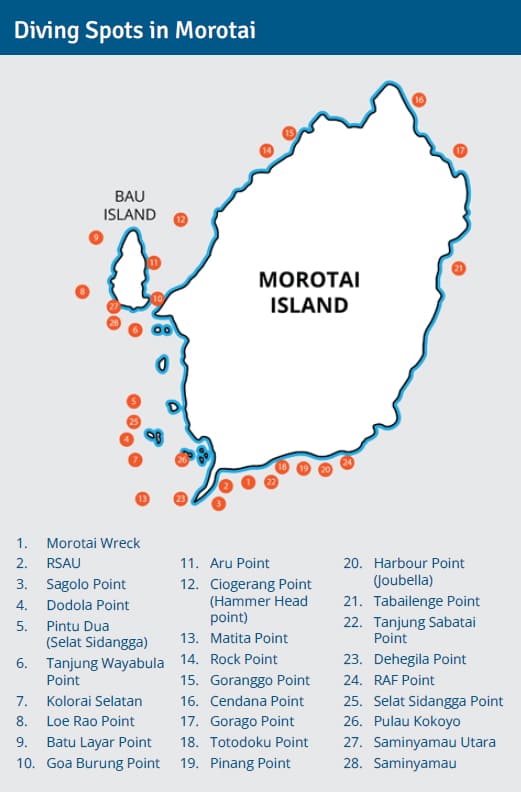 Morotai Island, one of Indonesia’s northernmost islands, sits just above the equator near the Pacific. Rugged and forested, it covers 2,476 square kilometers, with Daruba as the main town and most communities residing in traditional coastal villages. Morotai holds historical importance from World War II, when General MacArthur used it as a base to launch the Philippines campaign. Over 61,000 U.S. troops were stationed here, leaving behind sunken military equipment and occasional wartime relics still discovered on land.
How To Get There
- Fly to Morotai Leo Wattimena Airport (OTI)
- Ships from Ternate to Morotai (10 -11 hours) are also available. Please check for schedules.
Diving Conditions
Diving in Morotai is possible year-round, with the calmest conditions from late March to early July. The island’s shape provides natural shelter, ensuring diveable sites in most seasons. Sites include walls, drop-offs, and gentle coral gardens, offering options suitable for both beginners and experienced divers.
Visibility : 15 - 30 m
Best Time : Mar - Jul
Marginally cooler Jan–Mar.
Dive Site and Marine Life Highlights in Morotai
Morotai is emerging as a top shark diving destination, with regular sightings of blacktip, whitetip, and grey reef sharks at nearly every site. The waters are rich with marine life, including fusiliers, barracuda, tuna, devil rays, turtles, wrasse, and the occasional manta ray. Adding to its underwater allure are World War II wrecks—planes, tanks, and trucks—scattered near the old wartime airfield, some at depths suited to advanced divers. Top shark sites include Terminal Gorango, Blacktip Point, Grey Shark Point, and Rifky Point near Tabailenge Island. Aru Point features colorful walls and healthy coral, while Rifky Point is a macro hotspot with a variety of critters and schooling fish. Snorkelers and freedivers will enjoy coral-rich fringing reefs with easy access and sightings of turtles, rays, and reef sharks. Best visited from March to July, Morotai offers raw natural beauty and warm local hospitality, with basic facilities that cater to travelers seeking authenticity over luxury.
MOROTAI
Morotai Island, one of Indonesia’s northernmost islands, sits just above the equator near the Pacific. Rugged and forested, it covers 2,476 square kilometers, with Daruba as the main town and most communities residing in traditional coastal villages. Morotai holds historical importance from World War II, when General MacArthur used it as a base to launch the Philippines campaign. Over 61,000 U.S. troops were stationed here, leaving behind sunken military equipment and occasional wartime relics still discovered on land.
How To Get There
- Fly to Morotai Leo Wattimena Airport (OTI)
- Ships from Ternate to Morotai (10 -11 hours) are also available. Please check for schedules.
Diving Conditions
Diving in Morotai is possible year-round, with the calmest conditions from late March to early July. The island’s shape provides natural shelter, ensuring diveable sites in most seasons. Sites include walls, drop-offs, and gentle coral gardens, offering options suitable for both beginners and experienced divers.
Visibility : 15 - 30 m
Best Time : Mar - Jul
Marginally cooler Jan–Mar.
Dive Site and Marine Life Highlights in Morotai
Morotai is emerging as a top shark diving destination, with regular sightings of blacktip, whitetip, and grey reef sharks at nearly every site. The waters are rich with marine life, including fusiliers, barracuda, tuna, devil rays, turtles, wrasse, and the occasional manta ray. Adding to its underwater allure are World War II wrecks—planes, tanks, and trucks—scattered near the old wartime airfield, some at depths suited to advanced divers. Top shark sites include Terminal Gorango, Blacktip Point, Grey Shark Point, and Rifky Point near Tabailenge Island. Aru Point features colorful walls and healthy coral, while Rifky Point is a macro hotspot with a variety of critters and schooling fish. Snorkelers and freedivers will enjoy coral-rich fringing reefs with easy access and sightings of turtles, rays, and reef sharks. Best visited from March to July, Morotai offers raw natural beauty and warm local hospitality, with basic facilities that cater to travelers seeking authenticity over luxury.


