
SULAWESI The Land of Thousands Megalith
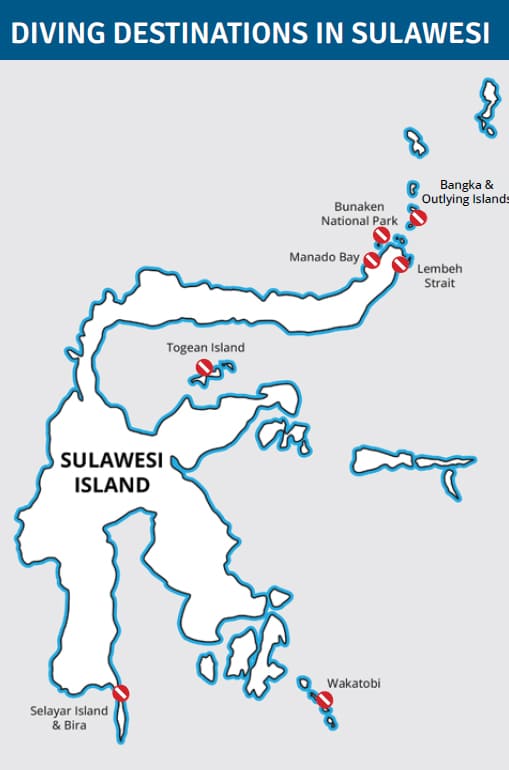 Sulawesi, Indonesia’s fourth-largest island, is renowned for its rich biodiversity, cultural diversity, and world-class diving. Spanning six provinces, its landscapes range from pristine coastlines to lush mountains and fertile plains. The island is home to distinct ethnic groups, including the Toraja, Bugis, and Minahasa, which reflect a blend of Muslim and Christian communities. Cultural and historical highlights include ancient megaliths in Tana Toraja and Minahasa. Encircled by vibrant seas, Sulawesi offers premier diving across its northern, central, and southern coasts. Inland,agriculture and fishing thrive, supported by vast natural resources including gold and nickel. With its striking geography, deep-rooted traditions, and marine richness, Sulawesi offers an unforgettable journey for both cultural explorers and diving enthusiasts.
Central & Southern Sulawesi Diving Overview
Central and Southern Sulawesi are home to some of Indonesia’s most untouched beaches and premier dive sites. Destinations like Selayar, Bira, Wakatobi, and the Togean Islands offer dramatic walls and exceptional coral diversity, characteristic of their location within the heart of the Coral Triangle. Diving is possible year-round, with generally clear visibility, calm seas, and less rainfall than many other regions of Indonesia. Selayar, however, operates seasonally from October to May, as swells from May to September can limit access to its eastern coast.
Diving Conditions
Diving around Sulawesi is generally easy, with mild currents and deep wall dives teeming with marine life and vibrant corals. Snorkeling and freediving in Central and Southern Sulawesi reveal pristine reefs, warm waters, and encounters with turtles, rays, and even whale sharks. Though remote, these uncrowded sites offer a truly off-the-beaten-path underwater experience
Dive Site and Marine Life Highlights Central & Southern SULAWESI
Exploring Sulawesi's waters reveals vibrant reefs, dramatic walls, and an incredible diversity of marine life, featuring hundreds of fish and coral species. Wakatobi dazzles with its colorful, biodiverse reefs, while Selayar offers rich macro life and sightings of sharks, including hammerheads and grey reefs. Bira delivers adrenaline-pumping drifts and pelagic encounters, and the Togean Islands provide calm, scenic dives ideal for all levels. In Gorontalo, healthy coral formations and the chance to see whale sharks add to Sulawesi’s underwater allure.
Northern Sulawesi Diving Overview
Northern Sulawesi offers some of Indonesia’s most diverse and rewarding diving, from the world-renowned muck sites of Lembeh Strait to the dramatic walls of Bunaken and the vibrant coral reefs around Bangka and Gangga. Situated along a migratory route, the region also offers whale sightings and frequent dolphin encounters, alongside a diverse array of marine life that spans from tiny critters in Lembeh to large pelagics in Bunaken. Shipwrecks in Manado Bay adds further variety, making this a top destination for both macro and wide-angle underwater
photography.
Diving Conditions
Diving in Northern Sulawesi is generally calm and beginner-friendly, offering a range of sites that vary from steep walls to gentle sandy slopes. While most areas offer easy conditions, currents can pick up around Bunaken, Bangka, and Gangga, especially during full moons. Lembeh Strait and Manado Bay are typically sheltered, though wind and swell may occasionally affect shore dives. Bunaken’s geography ensures that at least one side remains diveable in most weather. Visibility is consistently good on reefs and walls year-round but can drop at muck sites like Lembeh during the rainy season due to runoff. Bunaken also offers excellent snorkeling and freediving, with frequent sightings of turtles, sea snakes, and vibrant coral gardens. Lembeh’s critter-rich waters often have lower visibility, though the north and east sides tend to be clearer. Bangka and Gangga deliver strong visibility and rich marine diversity, making them ideal for divers of all levels.
Dive Site and Marine Life Highlights Northern SULAWESI
Northern Sulawesi is teeming with marine life, offering encounters with dolphins, pilot whales, seasonal sperm whales, and dugongs, particularly around Bangka and Bunaken. Bunaken is primarily known for its abundant green sea turtles. At the same time, Lembeh Strait has earned global acclaim for muck diving, revealing rare and elusive critters such as blue-ring octopuses, pygmy seahorses, hairy frogfish, and flamboyant cuttlefish. Theregion is also home to unique endemic species, including the Lembeh sea dragon and the Banggai cardinalfish.
SULAWESI The Land of Thousands Megalith
Sulawesi, Indonesia’s fourth-largest island, is renowned for its rich biodiversity, cultural diversity, and world-class diving. Spanning six provinces, its landscapes range from pristine coastlines to lush mountains and fertile plains. The island is home to distinct ethnic groups, including the Toraja, Bugis, and Minahasa, which reflect a blend of Muslim and Christian communities. Cultural and historical highlights include ancient megaliths in Tana Toraja and Minahasa. Encircled by vibrant seas, Sulawesi offers premier diving across its northern, central, and southern coasts. Inland,agriculture and fishing thrive, supported by vast natural resources including gold and nickel. With its striking geography, deep-rooted traditions, and marine richness, Sulawesi offers an unforgettable journey for both cultural explorers and diving enthusiasts.
Central & Southern Sulawesi Diving Overview
Central and Southern Sulawesi are home to some of Indonesia’s most untouched beaches and premier dive sites. Destinations like Selayar, Bira, Wakatobi, and the Togean Islands offer dramatic walls and exceptional coral diversity, characteristic of their location within the heart of the Coral Triangle. Diving is possible year-round, with generally clear visibility, calm seas, and less rainfall than many other regions of Indonesia. Selayar, however, operates seasonally from October to May, as swells from May to September can limit access to its eastern coast.
Diving Conditions
Diving around Sulawesi is generally easy, with mild currents and deep wall dives teeming with marine life and vibrant corals. Snorkeling and freediving in Central and Southern Sulawesi reveal pristine reefs, warm waters, and encounters with turtles, rays, and even whale sharks. Though remote, these uncrowded sites offer a truly off-the-beaten-path underwater experience
Dive Site and Marine Life Highlights Central & Southern SULAWESI
Exploring Sulawesi's waters reveals vibrant reefs, dramatic walls, and an incredible diversity of marine life, featuring hundreds of fish and coral species. Wakatobi dazzles with its colorful, biodiverse reefs, while Selayar offers rich macro life and sightings of sharks, including hammerheads and grey reefs. Bira delivers adrenaline-pumping drifts and pelagic encounters, and the Togean Islands provide calm, scenic dives ideal for all levels. In Gorontalo, healthy coral formations and the chance to see whale sharks add to Sulawesi’s underwater allure.
Northern Sulawesi Diving Overview
Northern Sulawesi offers some of Indonesia’s most diverse and rewarding diving, from the world-renowned muck sites of Lembeh Strait to the dramatic walls of Bunaken and the vibrant coral reefs around Bangka and Gangga. Situated along a migratory route, the region also offers whale sightings and frequent dolphin encounters, alongside a diverse array of marine life that spans from tiny critters in Lembeh to large pelagics in Bunaken. Shipwrecks in Manado Bay adds further variety, making this a top destination for both macro and wide-angle underwater
photography.
Diving Conditions
Diving in Northern Sulawesi is generally calm and beginner-friendly, offering a range of sites that vary from steep walls to gentle sandy slopes. While most areas offer easy conditions, currents can pick up around Bunaken, Bangka, and Gangga, especially during full moons. Lembeh Strait and Manado Bay are typically sheltered, though wind and swell may occasionally affect shore dives. Bunaken’s geography ensures that at least one side remains diveable in most weather. Visibility is consistently good on reefs and walls year-round but can drop at muck sites like Lembeh during the rainy season due to runoff. Bunaken also offers excellent snorkeling and freediving, with frequent sightings of turtles, sea snakes, and vibrant coral gardens. Lembeh’s critter-rich waters often have lower visibility, though the north and east sides tend to be clearer. Bangka and Gangga deliver strong visibility and rich marine diversity, making them ideal for divers of all levels.
Dive Site and Marine Life Highlights Northern SULAWESI
Northern Sulawesi is teeming with marine life, offering encounters with dolphins, pilot whales, seasonal sperm whales, and dugongs, particularly around Bangka and Bunaken. Bunaken is primarily known for its abundant green sea turtles. At the same time, Lembeh Strait has earned global acclaim for muck diving, revealing rare and elusive critters such as blue-ring octopuses, pygmy seahorses, hairy frogfish, and flamboyant cuttlefish. Theregion is also home to unique endemic species, including the Lembeh sea dragon and the Banggai cardinalfish.
WAKATOBI (THE TUKANGBESI ARCHIPELAGO)
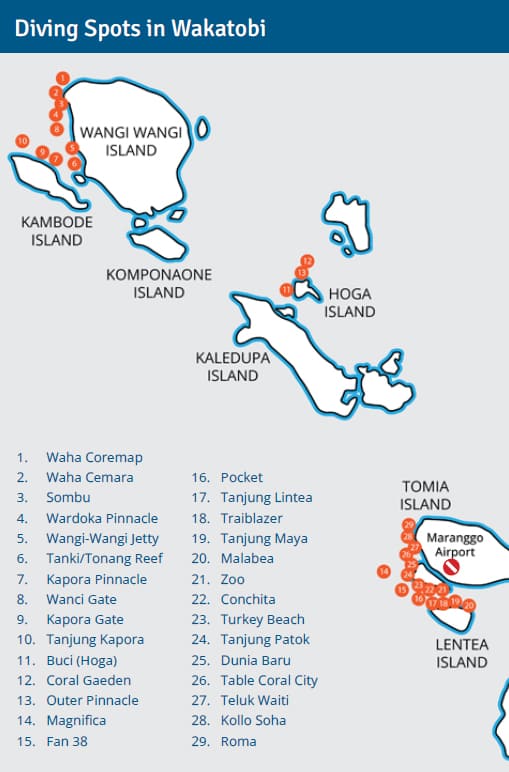 Wakatobi, located in the Banda Sea southeast of Sulawesi, is famed for its pristine fringing, atoll, and barrier reefs. Named after its four main islands—Wangi-Wangi, Kaledupa, Tomia, and Binongko—it offers worldclass diving once hailed by Jacques Cousteau. The best diving can be found around Tomia and Wangi-Wangi, where Wakatobi’s fossilized reefs remain pristine within a protected marine park, supported by the seafaring Bajau community. Remote and uncrowded, Wakatobi continues to unveil new sites, making it a prime destination for vibrant reefs and authentic culture.
How To Get There
- Fly to Kendari Haluoleo Airport (KDI)
- Boat trip from Kendari to Wakatobi (about 13-15 hours)
- Fly to Wakatobi Matahora Airport (WNI) on Wangi-Wangi Island from Kendari Haluoleo Airport (KDI)
Diving Conditions
Wakatobi offers dive conditions suited to all experience levels. Shallow sand-bottom sites are perfect for
beginners, while steep walls, sloping reefs, and deep drift sites challenge advanced and technical divers.
Visibility : 10 - 25 m
Best Time : Year Around
Generally stable; modest cooling Jun–Aug to 26–28°C.
Dive Site and Marine Life Highlights in Wakatobi
Wakatobi has an exceptional range of experiences for divers and snorkelers alike, from elusive macro critters to impressive pelagics. Sites like Coral Garden and Cornucopia showcase vibrant coral, reef fish, sharks, eagle rays, and mobulas along sheltered bowls and current-swept walls. The famous House Reef at Wakatobi Resort teems with biodiversity, making it a favorite for underwater photographers. At Roma, a pinnacle site, divers encounter schools of fusiliers, sea snakes, stingrays, and macro life such as ribbon and leaf scorpionfish. Snorkelers and freedivers are treated to warm, clear waters and flourishing shallow reefs home to reef sharks, turtles, moray eels, lionfish, and clownfish colonies. With varied underwater topography—ranging from gentle slopes to dramatic dropoffs— and consistently good visibility, Wakatobi offers rewarding exploration for all skill levels, year-round.
WAKATOBI (THE TUKANGBESI ARCHIPELAGO)
Wakatobi, located in the Banda Sea southeast of Sulawesi, is famed for its pristine fringing, atoll, and barrier reefs. Named after its four main islands—Wangi-Wangi, Kaledupa, Tomia, and Binongko—it offers worldclass diving once hailed by Jacques Cousteau. The best diving can be found around Tomia and Wangi-Wangi, where Wakatobi’s fossilized reefs remain pristine within a protected marine park, supported by the seafaring Bajau community. Remote and uncrowded, Wakatobi continues to unveil new sites, making it a prime destination for vibrant reefs and authentic culture.
How To Get There
- Fly to Kendari Haluoleo Airport (KDI)
- Boat trip from Kendari to Wakatobi (about 13-15 hours)
- Fly to Wakatobi Matahora Airport (WNI) on Wangi-Wangi Island from Kendari Haluoleo Airport (KDI)
Diving Conditions
Wakatobi offers dive conditions suited to all experience levels. Shallow sand-bottom sites are perfect for
beginners, while steep walls, sloping reefs, and deep drift sites challenge advanced and technical divers.
Visibility : 10 - 25 m
Best Time : Year Around
Generally stable; modest cooling Jun–Aug to 26–28°C.
Dive Site and Marine Life Highlights in Wakatobi
Wakatobi has an exceptional range of experiences for divers and snorkelers alike, from elusive macro critters to impressive pelagics. Sites like Coral Garden and Cornucopia showcase vibrant coral, reef fish, sharks, eagle rays, and mobulas along sheltered bowls and current-swept walls. The famous House Reef at Wakatobi Resort teems with biodiversity, making it a favorite for underwater photographers. At Roma, a pinnacle site, divers encounter schools of fusiliers, sea snakes, stingrays, and macro life such as ribbon and leaf scorpionfish. Snorkelers and freedivers are treated to warm, clear waters and flourishing shallow reefs home to reef sharks, turtles, moray eels, lionfish, and clownfish colonies. With varied underwater topography—ranging from gentle slopes to dramatic dropoffs— and consistently good visibility, Wakatobi offers rewarding exploration for all skill levels, year-round.
THE TOGEAN ISLANDS (CENTRAL SULAWESI)
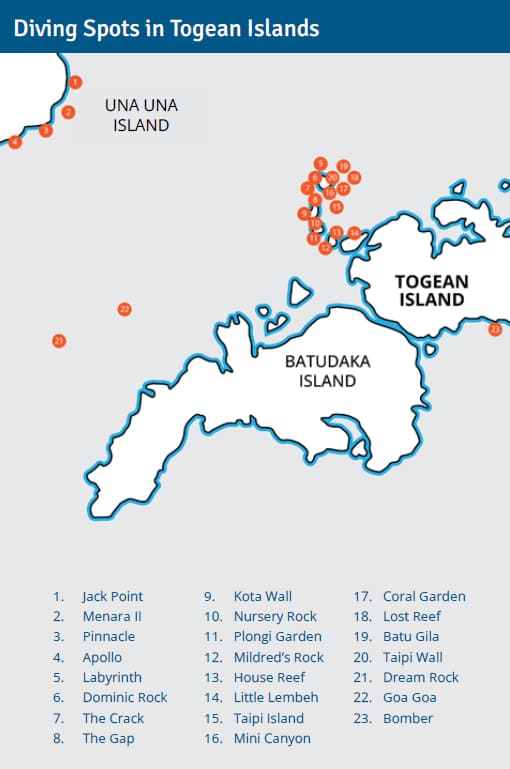 The Togean Islands in Central Sulawesi offer secluded and uncrowded diving, featuring vibrant wall dives off Kadidiri, a rich marine biodiversity around Una Una, and excellent muck diving for macro enthusiasts. Access is via ferry to Wakai from Gorontalo or Ampana, with most dive resorts on Kadidiri providing pickup services. critters. With very few operators in the area, diving in the Togean Islands offers an exclusive experience. Though remote, the journey is well worth it—white sand beaches, turquoise lagoons, and pristine coral reefs await. With dramatic walls, caverns, and dense coral cover, the Togeans remain a hidden gem in Indonesia’s dive landscape.
How To Get There
- Fly to Gorontalo Djalaluddin Airport (GTO) in Gorontalo Province or to Ampana Tanjung Api Airport (OJU) in Central Sulawesi Province
- Ferry trip to Wakai from Gorontalo (North route – 3 hours) or Ampana (South route 4 - 5 hours)
- Final transfer by boat is usually arranged by your resort or local operator
Diving Conditions
Kadidiri is known for its muck dives, vibrant coral reefs, and walls, while Una Una offers richer fish life, pelagics, and a striking underwater pinnacle. Notable highlights include a submerged B-24 bomber wreck and a jellyfish lake, perfect for unique snorkeling and photography experiences. Snorkelers and freedivers are drawn to the Togeans for their clear waters, thriving reefs, and occasional pelagic encounters. Still remote and uncrowded, the region offers a tranquil diving experience, with stronger currents near Una Una best navigated with boat support.
Visibility : 10 - 20 m
Best Time : May - Oct
Tomini Bay is sheltered—very stable 28–30°C year round.
Dive Site and Marine Life Highlights in the Togean Islands
North of Kadidiri, sites like the Labyrinth, Catacomb, and Mini Canyon offer coral-rich seamounts with caverns, boulders, and a diverse array of marine life, ranging from eagle rays to nudibranchs. Una Una delivers fish-filled dives at deep-wall sites such as The Pinnacle and Menara Dua, where fusiliers, turtles, and barracuda are common. Just north of Kadidiri, Little Lembeh is a top muck diving site, renowned for its diverse array of critters, including seahorses and cuttlefish.
THE TOGEAN ISLANDS (CENTRAL SULAWESI)
The Togean Islands in Central Sulawesi offer secluded and uncrowded diving, featuring vibrant wall dives off Kadidiri, a rich marine biodiversity around Una Una, and excellent muck diving for macro enthusiasts. Access is via ferry to Wakai from Gorontalo or Ampana, with most dive resorts on Kadidiri providing pickup services. critters. With very few operators in the area, diving in the Togean Islands offers an exclusive experience. Though remote, the journey is well worth it—white sand beaches, turquoise lagoons, and pristine coral reefs await. With dramatic walls, caverns, and dense coral cover, the Togeans remain a hidden gem in Indonesia’s dive landscape.
How To Get There
- Fly to Gorontalo Djalaluddin Airport (GTO) in Gorontalo Province or to Ampana Tanjung Api Airport (OJU) in Central Sulawesi Province
- Ferry trip to Wakai from Gorontalo (North route – 3 hours) or Ampana (South route 4 - 5 hours)
- Final transfer by boat is usually arranged by your resort or local operator
Diving Conditions
Kadidiri is known for its muck dives, vibrant coral reefs, and walls, while Una Una offers richer fish life, pelagics, and a striking underwater pinnacle. Notable highlights include a submerged B-24 bomber wreck and a jellyfish lake, perfect for unique snorkeling and photography experiences. Snorkelers and freedivers are drawn to the Togeans for their clear waters, thriving reefs, and occasional pelagic encounters. Still remote and uncrowded, the region offers a tranquil diving experience, with stronger currents near Una Una best navigated with boat support.
Visibility : 10 - 20 m
Best Time : May - Oct
Tomini Bay is sheltered—very stable 28–30°C year round.
Dive Site and Marine Life Highlights in the Togean Islands
North of Kadidiri, sites like the Labyrinth, Catacomb, and Mini Canyon offer coral-rich seamounts with caverns, boulders, and a diverse array of marine life, ranging from eagle rays to nudibranchs. Una Una delivers fish-filled dives at deep-wall sites such as The Pinnacle and Menara Dua, where fusiliers, turtles, and barracuda are common. Just north of Kadidiri, Little Lembeh is a top muck diving site, renowned for its diverse array of critters, including seahorses and cuttlefish.
SELAYAR ISLAND & BIRA
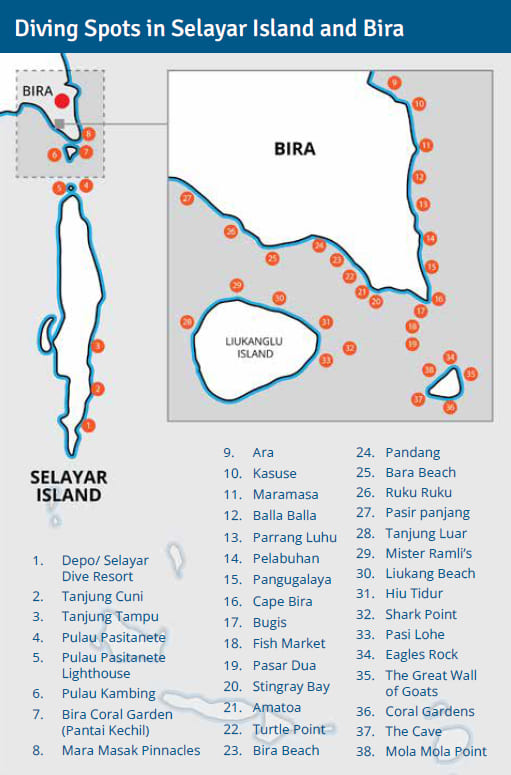 Selayar Island and its nearby Bira are located in the southern part of Sulawesi. They offer spectacular diving, featuring vibrant coral walls, abundant macro life, turtles, and pelagics, including rays and sharks. Selayar’s top dive sites lie within a protected marine park managed by Selayar Dive Resort, reachable via a 2.5-hour speedboat trip from Bira or limited domestic flights from Makassar. Bira, renowned for its traditional Phinisi shipbuilding, is a coastal town approximately 4 - 5 hours by road from Makassar. It features beautiful beaches and provides dive access to nearby Pulau Kambing and Pulau Pasi, though strong currents are common. Selayar’s undeveloped east and southern coasts reveal a rugged natural beauty, featuring waterfalls, forested peaks, and turquoise bays. The diving season runs from October to May, while rough seas and resort closures typically occur during the May–October period, when the prevailing winds are from the east. Transfers require careful planning, and using your dive operator’s assistance is highly recommended for reaching this remote, rewarding destination.
How To Get There
- Fly to Makassar Sultan Hasanuddin International Airport (UPG)
- Transfer by car (4 - 5 hours) to Bira for boat transfer
- Boat transfer to Selayar Island (2 - 3 hours)
Diving Conditions
Diving in Bira is best suited for experienced divers, as strong currents and unpredictable conditions can impact visibility and safety. In southeast Selayar, dive conditions vary from calm to challenging drifts depending on the tides. The protected marine area, managed by Selayar Dive Resort, features dramatic walls with overhangs, caverns, and swim-throughs, all teeming with coral diversity and a rich array of pelagic life.
Visibility : 15 - 30 m
Best Time : Mar - Oct
Upwelling Jul–Sep with thermoclines to 25–27°C.
Dive Site and Marine Life Highlights in Selayar Island and Bira
Selayar Dive Resort’s marine protected area offers an impressive mix of critter life and larger pelagics, set against stunning walls and vibrant reefscapes. With frequent shark sightings—featuring more species than most parts of Indonesia—the diving here consistently delivers for those seeking big fish encounters. Complemented by rich macro life and colourful, scenic reefs, it’s a destination that rarely leaves divers unimpressed.
SELAYAR ISLAND & BIRA
Selayar Island and its nearby Bira are located in the southern part of Sulawesi. They offer spectacular diving, featuring vibrant coral walls, abundant macro life, turtles, and pelagics, including rays and sharks. Selayar’s top dive sites lie within a protected marine park managed by Selayar Dive Resort, reachable via a 2.5-hour speedboat trip from Bira or limited domestic flights from Makassar. Bira, renowned for its traditional Phinisi shipbuilding, is a coastal town approximately 4 - 5 hours by road from Makassar. It features beautiful beaches and provides dive access to nearby Pulau Kambing and Pulau Pasi, though strong currents are common. Selayar’s undeveloped east and southern coasts reveal a rugged natural beauty, featuring waterfalls, forested peaks, and turquoise bays. The diving season runs from October to May, while rough seas and resort closures typically occur during the May–October period, when the prevailing winds are from the east. Transfers require careful planning, and using your dive operator’s assistance is highly recommended for reaching this remote, rewarding destination.
How To Get There
- Fly to Makassar Sultan Hasanuddin International Airport (UPG)
- Transfer by car (4 - 5 hours) to Bira for boat transfer
- Boat transfer to Selayar Island (2 - 3 hours)
Diving Conditions
Diving in Bira is best suited for experienced divers, as strong currents and unpredictable conditions can impact visibility and safety. In southeast Selayar, dive conditions vary from calm to challenging drifts depending on the tides. The protected marine area, managed by Selayar Dive Resort, features dramatic walls with overhangs, caverns, and swim-throughs, all teeming with coral diversity and a rich array of pelagic life.
Visibility : 15 - 30 m
Best Time : Mar - Oct
Upwelling Jul–Sep with thermoclines to 25–27°C.
Dive Site and Marine Life Highlights in Selayar Island and Bira
Selayar Dive Resort’s marine protected area offers an impressive mix of critter life and larger pelagics, set against stunning walls and vibrant reefscapes. With frequent shark sightings—featuring more species than most parts of Indonesia—the diving here consistently delivers for those seeking big fish encounters. Complemented by rich macro life and colourful, scenic reefs, it’s a destination that rarely leaves divers unimpressed.
BUNAKEN NATIONAL PARK
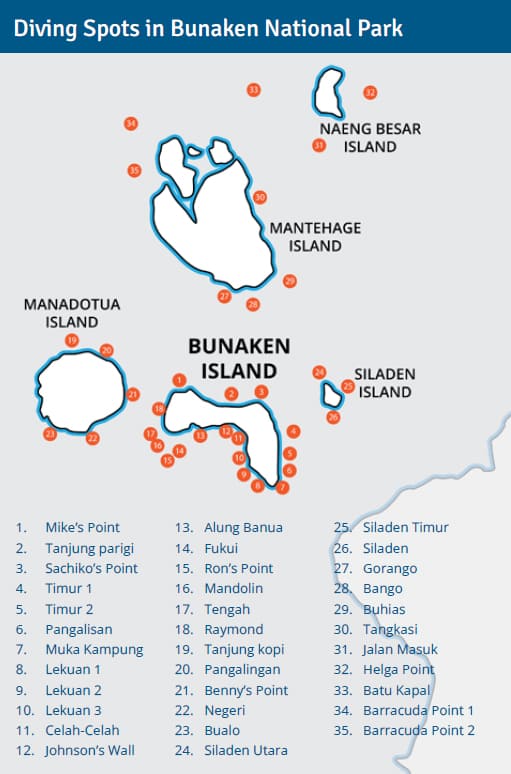 Bunaken National Park, established in the early 1990s as one of Indonesia’s first marine protected areas, sits at the heart of the Coral Triangle. Spanning 891 km²—97% of which is ocean—the park encompasses sea grass beds, vibrant coral reefs, and dramatic walls that drop over 1.5 kilometers deep. It’s home to 390 species of coral and a wealth of marine life, including the islands of Bunaken, Manado Tua, Siladen, Mantehage, and Nain.
How To Get There
- Fly to Manado Sam Ratulangi International Airport (MDC)
- Transfer by car to Calaca Harbour - (45 minutes) for boat transfer
- Boat trip from Calaca Harbour to Bunaken (45 - 60 minutes)
Diving Conditions
Most dive sites in Bunaken National Park are clustered around Bunaken Island, with additional spots off Manado Tua and Siladen. Visibility is excellent yearround, and currents are generally mild, becoming stronger only around the time of the full moon. Diving is rarely affected by weather, as the islands lack major rivers and runoff, and Bunaken’s geography offers natural protection from wind. With shallow reefs ideal for beginners and deep walls for advanced divers, the park caters to all skill levels.
Visibility : 20 - 40 m
Best Time : Mar - Oct
Mostly warm; mild cooling Jul–Sep.
Dive Site and Marine Life Highlights in Bunaken National Park
Bunaken’s dive sites are renowned for their steep coral walls, crystalclear visibility, and rich marine life. Divers frequently encounter reef sharks, eagle rays, sea snakes, schooling fish, and an abundance of turtles, with seasonal appearances by dolphins, dugongs, and even sperm whales. The iconic Lekuan I, II, and III walls are draped in massive sponges and both hard and soft corals, offering a visual feast for wide-angle and macro photographers alike. The vibrant reef tops burst with color and fish activity, while the walls harbor pygmy seahorses, orangutan crabs, frogfish, and a variety of shrimps and nudibranchs. Nearby Sachiko’s Point is famous for its gorgonian sea fans and regular sightings of barracudas, blacktip reef sharks, and Napoleon wrasse. Ron’s Point, renowned for its deep drop-offs and strong currents, attracts large pelagics, including tuna and jacks—ideal for advanced divers. Siladen Jetty features a lush reef wall with caverns and overhangs that shelter macro life, while Pangulingan, off Manado Tua, offers exhilarating drifts with batfish, jackfish, and barracuda. For a more high-adrenaline dive, Barracuda Point off Montehage delivers fast currents, excellent visibility, and large schools of barracuda and bumphead parrotfish. On the mainland fringe of the marine park, Tanjung Kelapa (Poopoh) adds diversity with black sand muck diving, seagrass beds, and coralcovered walls rich in marine life.
BUNAKEN NATIONAL PARK
Bunaken National Park, established in the early 1990s as one of Indonesia’s first marine protected areas, sits at the heart of the Coral Triangle. Spanning 891 km²—97% of which is ocean—the park encompasses sea grass beds, vibrant coral reefs, and dramatic walls that drop over 1.5 kilometers deep. It’s home to 390 species of coral and a wealth of marine life, including the islands of Bunaken, Manado Tua, Siladen, Mantehage, and Nain.
How To Get There
- Fly to Manado Sam Ratulangi International Airport (MDC)
- Transfer by car to Calaca Harbour - (45 minutes) for boat transfer
- Boat trip from Calaca Harbour to Bunaken (45 - 60 minutes)
Diving Conditions
Most dive sites in Bunaken National Park are clustered around Bunaken Island, with additional spots off Manado Tua and Siladen. Visibility is excellent yearround, and currents are generally mild, becoming stronger only around the time of the full moon. Diving is rarely affected by weather, as the islands lack major rivers and runoff, and Bunaken’s geography offers natural protection from wind. With shallow reefs ideal for beginners and deep walls for advanced divers, the park caters to all skill levels.
Visibility : 20 - 40 m
Best Time : Mar - Oct
Mostly warm; mild cooling Jul–Sep.
Dive Site and Marine Life Highlights in Bunaken National Park
Bunaken’s dive sites are renowned for their steep coral walls, crystalclear visibility, and rich marine life. Divers frequently encounter reef sharks, eagle rays, sea snakes, schooling fish, and an abundance of turtles, with seasonal appearances by dolphins, dugongs, and even sperm whales. The iconic Lekuan I, II, and III walls are draped in massive sponges and both hard and soft corals, offering a visual feast for wide-angle and macro photographers alike. The vibrant reef tops burst with color and fish activity, while the walls harbor pygmy seahorses, orangutan crabs, frogfish, and a variety of shrimps and nudibranchs. Nearby Sachiko’s Point is famous for its gorgonian sea fans and regular sightings of barracudas, blacktip reef sharks, and Napoleon wrasse. Ron’s Point, renowned for its deep drop-offs and strong currents, attracts large pelagics, including tuna and jacks—ideal for advanced divers. Siladen Jetty features a lush reef wall with caverns and overhangs that shelter macro life, while Pangulingan, off Manado Tua, offers exhilarating drifts with batfish, jackfish, and barracuda. For a more high-adrenaline dive, Barracuda Point off Montehage delivers fast currents, excellent visibility, and large schools of barracuda and bumphead parrotfish. On the mainland fringe of the marine park, Tanjung Kelapa (Poopoh) adds diversity with black sand muck diving, seagrass beds, and coralcovered walls rich in marine life.
MANADO BAY
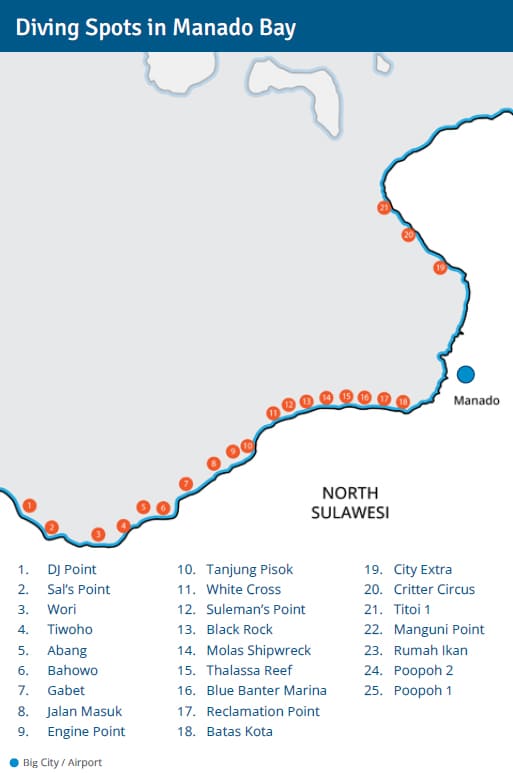 Manado Bay is gaining recognition for its outstanding muck diving and rare macro marine life, with black and white sand slopes that provide ideal conditions for underwater photography.
How To Get There
- Fly to Manado Sam Ratulangi International Airport (MDC)
- Transfer by car to the Bay Area (15 to 20 minutes)
Diving Conditions
Manado Bay offers generally calm diving conditions yearround, with minimal currents except during full moon tides. The bay’s shallow, sandy reefs and easy shore access make it especially suitable for beginner divers.
Visibility : 10 - 25 m
Best Time : Year Around
Slight cooling Jul–Sep.
Dive Site and Marine Life Highlights in Manado Bay
Tiwoho and Wori Bay are renowned muck diving hotspots in Manado Bay, home to iconic critters like ghost pipefish, frogfish, ribbon eels, nudibranchs, and various cephalopods— making them a haven for macro photography enthusiasts. City Extra features seagrass beds with seahorses and a sandy slope frequented by frogfish, flamboyant cuttlefish, and mimic octopuses. The Molas Wreck, believed to be a Dutch World War II cargo ship, rests at a depth of 24 to 42 meters and is often visited by white-tip reef sharks and Napoleon wrasses. At Tanjung Papaya, an artificial reef constructed from coral-covered motorbikes attracts lionfish, moray eels, nudibranchs, and other bottomdwelling creatures. While less vibrant than neighbouring Bunaken, Manado Bay offers easily accessible snorkelling and freediving over its shallow reef-and-sand habitats.
MANADO BAY
Manado Bay is gaining recognition for its outstanding muck diving and rare macro marine life, with black and white sand slopes that provide ideal conditions for underwater photography.
How To Get There
- Fly to Manado Sam Ratulangi International Airport (MDC)
- Transfer by car to the Bay Area (15 to 20 minutes)
Diving Conditions
Manado Bay offers generally calm diving conditions yearround, with minimal currents except during full moon tides. The bay’s shallow, sandy reefs and easy shore access make it especially suitable for beginner divers.
Visibility : 10 - 25 m
Best Time : Year Around
Slight cooling Jul–Sep.
Dive Site and Marine Life Highlights in Manado Bay
Tiwoho and Wori Bay are renowned muck diving hotspots in Manado Bay, home to iconic critters like ghost pipefish, frogfish, ribbon eels, nudibranchs, and various cephalopods— making them a haven for macro photography enthusiasts. City Extra features seagrass beds with seahorses and a sandy slope frequented by frogfish, flamboyant cuttlefish, and mimic octopuses. The Molas Wreck, believed to be a Dutch World War II cargo ship, rests at a depth of 24 to 42 meters and is often visited by white-tip reef sharks and Napoleon wrasses. At Tanjung Papaya, an artificial reef constructed from coral-covered motorbikes attracts lionfish, moray eels, nudibranchs, and other bottomdwelling creatures. While less vibrant than neighbouring Bunaken, Manado Bay offers easily accessible snorkelling and freediving over its shallow reef-and-sand habitats.
THE LEMBEH STRAIT
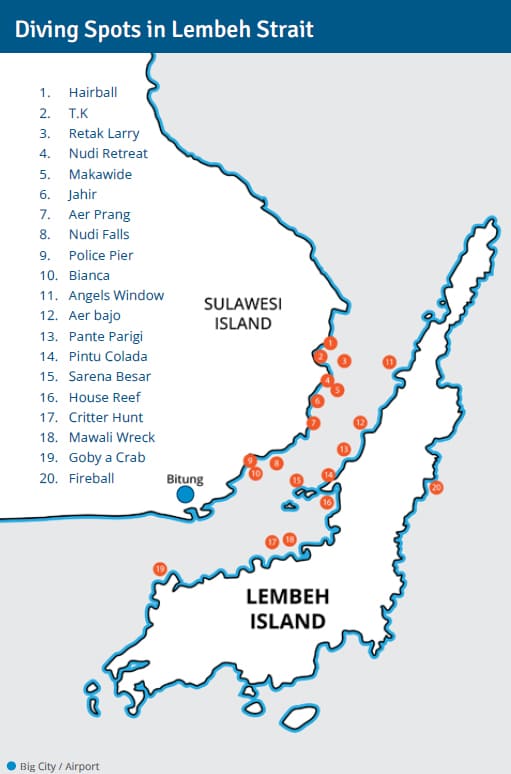 The Lembeh Strait, located between Lembeh Island and the mainland of North Sulawesi, is world-renowned for its muck diving on volcanic black sand. Nicknamed the 'Critter Capital of the World,' it boasts an extraordinary array of rare and camouflaged species, drawing underwater photographers, scientists, and macro enthusiasts from around the globe. While best known for muck diving, the Strait’s northern end also features coral reef sites, and the seldom-explored east coast of Lembeh offers vibrant soft corals, schooling fish, and occasional pelagic encounters.
How To Get There
- Fly to Manado Sam Ratulangi International Airport (MDC)
- Transfer by car to Bitung (90 minutes) for boat transfer
- Short boat trip from Bitung to Lembeh Island (15 minutes)
Diving Conditions
The Lembeh Strait offers calm, year-round diving with minimal currents, making it ideal for beginners. With its shallow sandy sites and abundance of rare marine life, Lembeh is a perfect destination for both novice divers and experienced macro enthusiasts.
Visibility : 10 - 20 m
Best Time : May - Oct
Slightly cooler Jul–Sep with thermoclines to 26–28°C.
Dive Site and Marine Life Highlights in Lembeh Strait
The Lembeh Strait is renowned for its exceptional macro life, boasting one of the world’s richest collections of rare critters— including pygmy seahorses, frogfish, flamboyant cuttlefish, blueringed octopuses, and rhinopias. Iconic dive sites like Hairball, TK, Jahir, and Air Bajo are favourites for muck diving, while combination reef-sand sites such as Nudifalls and Serena offer added variety. The WWII-era Mawali Wreck adds historical intrigue and wide-angle photography opportunities. Beyond muck diving, Lembeh’s north and east coasts feature colourful coral reefs, schooling fish, reef sharks, and occasional sightings of rays or cetaceans. Notable sites include Angel’s Window and Fireball. While visibility can be limited for snorkelers, sites like Nudi Falls and Batu Angus provide vibrant coral, abundant marine life, and even birdwatching opportunities from the boat.
THE LEMBEH STRAIT
The Lembeh Strait, located between Lembeh Island and the mainland of North Sulawesi, is world-renowned for its muck diving on volcanic black sand. Nicknamed the 'Critter Capital of the World,' it boasts an extraordinary array of rare and camouflaged species, drawing underwater photographers, scientists, and macro enthusiasts from around the globe. While best known for muck diving, the Strait’s northern end also features coral reef sites, and the seldom-explored east coast of Lembeh offers vibrant soft corals, schooling fish, and occasional pelagic encounters.
How To Get There
- Fly to Manado Sam Ratulangi International Airport (MDC)
- Transfer by car to Bitung (90 minutes) for boat transfer
- Short boat trip from Bitung to Lembeh Island (15 minutes)
Diving Conditions
The Lembeh Strait offers calm, year-round diving with minimal currents, making it ideal for beginners. With its shallow sandy sites and abundance of rare marine life, Lembeh is a perfect destination for both novice divers and experienced macro enthusiasts.
Visibility : 10 - 20 m
Best Time : May - Oct
Slightly cooler Jul–Sep with thermoclines to 26–28°C.
Dive Site and Marine Life Highlights in Lembeh Strait
The Lembeh Strait is renowned for its exceptional macro life, boasting one of the world’s richest collections of rare critters— including pygmy seahorses, frogfish, flamboyant cuttlefish, blueringed octopuses, and rhinopias. Iconic dive sites like Hairball, TK, Jahir, and Air Bajo are favourites for muck diving, while combination reef-sand sites such as Nudifalls and Serena offer added variety. The WWII-era Mawali Wreck adds historical intrigue and wide-angle photography opportunities. Beyond muck diving, Lembeh’s north and east coasts feature colourful coral reefs, schooling fish, reef sharks, and occasional sightings of rays or cetaceans. Notable sites include Angel’s Window and Fireball. While visibility can be limited for snorkelers, sites like Nudi Falls and Batu Angus provide vibrant coral, abundant marine life, and even birdwatching opportunities from the boat.
BANGKA & OUTLYING ISLANDS (GANGGA, TALISEI & LIHAGA)
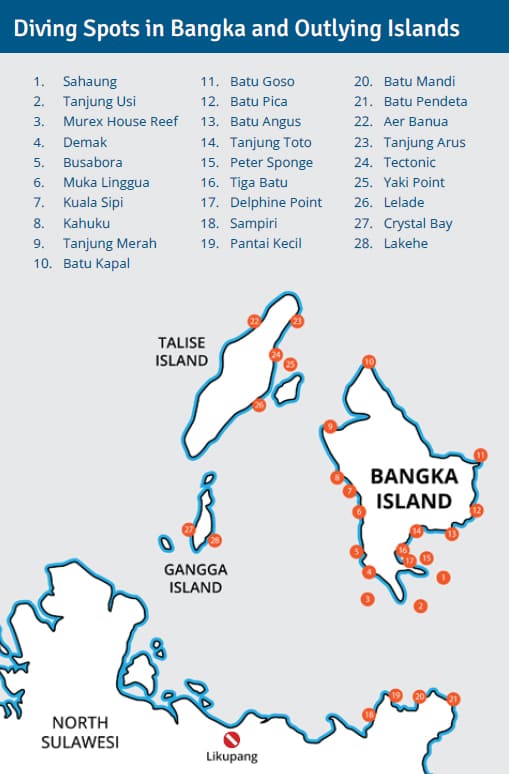 Bangka Island, located just off the northern tip of North Sulawesi, offers a remote tropical escape characterized by small village communities and minimal development. The islands of Bangka, Gangga, Talisei, and Lihaga are known for their stunning coastlines, white sand beaches, and vibrant coral reefs. Divers and snorkelers can explore dramatic rock pinnacles, sea mounts, and coral-filled coves teeming with a diverse array of marine life. Migrating whales, dolphins, pelagics, and dugongs are frequently spotted, while macro enthusiasts will find Lembeh-style critters in more colorful surroundings. Nutrient-rich currents support abundant fish life and flourishing soft coral gardens—perfect for wide-angle photography.
How To Get There
- Fly to Manado Sam Ratulangi International Airport (MDC)
- Transfer by car to the northeastern coast (Likupang) (1.5 to 2 hours) for boat transfer
- Boat trip from Likupang to Bangka or nearby Islands
Diving Conditions
Diving around Bangka and Gangga shifts with the tides, often bringing stronger currents than Bunaken, especially at pinnacles and sloping reefs. Mainland and bay sites are more sheltered, offering calm bays, clear waters, and pristine beaches for snorkelers and freedivers—though some require boat support or caution with currents. The region combines thrilling drifts with plenty of gentle sites ideal for beginners.
Visibility : 15 - 30 m
Best Time : Mar - Oct
Mild seasonal cooling Jul–Sep.
Dive Site and Marine Life Highlights in Bangka and Outlying Islands
The Bangka Archipelago offers vibrant diving and snorkeling across a variety of iconic sites. At Sahaung, dramatic pinnacles, table corals, reef sharks, and flourishing soft corals create a spectacular marine tableau. Batu Pendeta’s rugged topography attracts large fish species, while Batu Mandi is a haven for critter enthusiasts—think frogfish, pygmy seahorses, and cuttlefish. Advanced divers will relish the colorful reefs and frequent pelagic encounters with Napoleon wrasse and tuna at Tectonic and Tanjung Arus. On Lihaga Island, dusk brings the unforgettable spectacle of mandarin fish mating displays.
BANGKA & OUTLYING ISLANDS (GANGGA, TALISEI & LIHAGA)
Bangka Island, located just off the northern tip of North Sulawesi, offers a remote tropical escape characterized by small village communities and minimal development. The islands of Bangka, Gangga, Talisei, and Lihaga are known for their stunning coastlines, white sand beaches, and vibrant coral reefs. Divers and snorkelers can explore dramatic rock pinnacles, sea mounts, and coral-filled coves teeming with a diverse array of marine life. Migrating whales, dolphins, pelagics, and dugongs are frequently spotted, while macro enthusiasts will find Lembeh-style critters in more colorful surroundings. Nutrient-rich currents support abundant fish life and flourishing soft coral gardens—perfect for wide-angle photography.
How To Get There
- Fly to Manado Sam Ratulangi International Airport (MDC)
- Transfer by car to the northeastern coast (Likupang) (1.5 to 2 hours) for boat transfer
- Boat trip from Likupang to Bangka or nearby Islands
Diving Conditions
Diving around Bangka and Gangga shifts with the tides, often bringing stronger currents than Bunaken, especially at pinnacles and sloping reefs. Mainland and bay sites are more sheltered, offering calm bays, clear waters, and pristine beaches for snorkelers and freedivers—though some require boat support or caution with currents. The region combines thrilling drifts with plenty of gentle sites ideal for beginners.
Visibility : 15 - 30 m
Best Time : Mar - Oct
Mild seasonal cooling Jul–Sep.
Dive Site and Marine Life Highlights in Bangka and Outlying Islands
The Bangka Archipelago offers vibrant diving and snorkeling across a variety of iconic sites. At Sahaung, dramatic pinnacles, table corals, reef sharks, and flourishing soft corals create a spectacular marine tableau. Batu Pendeta’s rugged topography attracts large fish species, while Batu Mandi is a haven for critter enthusiasts—think frogfish, pygmy seahorses, and cuttlefish. Advanced divers will relish the colorful reefs and frequent pelagic encounters with Napoleon wrasse and tuna at Tectonic and Tanjung Arus. On Lihaga Island, dusk brings the unforgettable spectacle of mandarin fish mating displays.


